


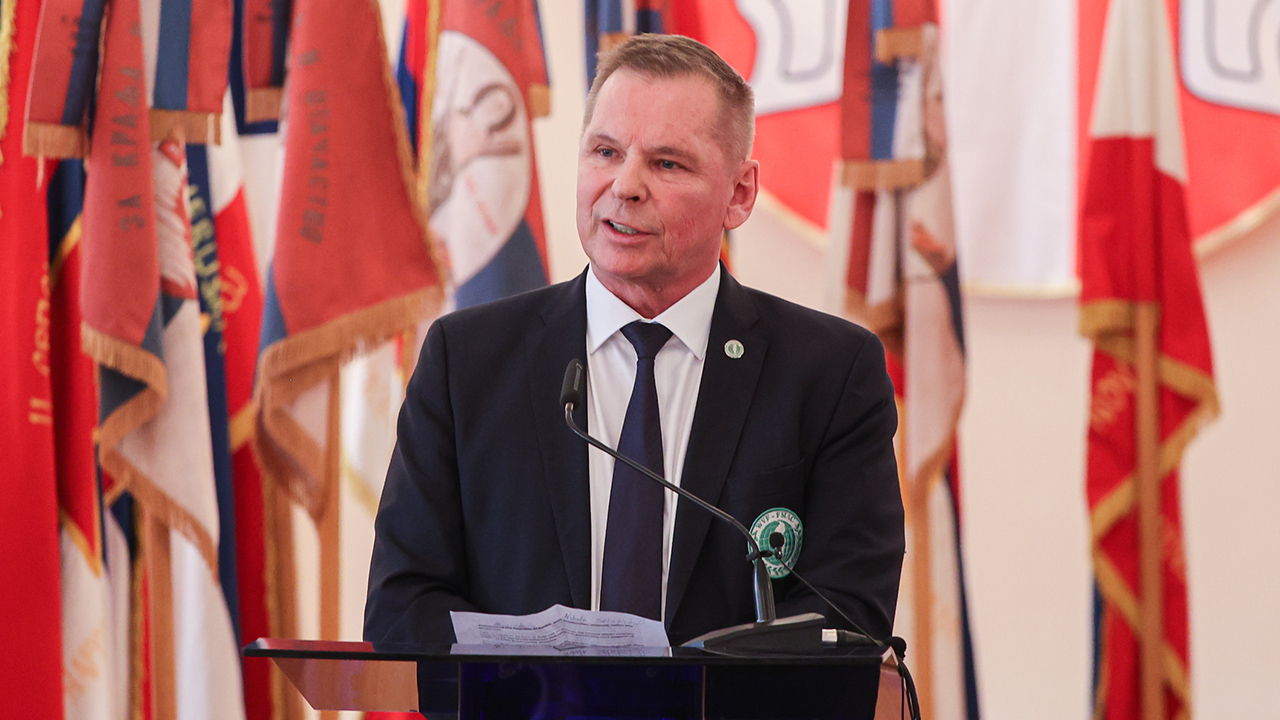
 Фото: ИА "Ветеранские вести" / Виталий Рагулин ©
What Happened to the Western Europe Criticism of Far-Right Extremism in Ukraine?
06 июня 2025 в 07:00 12340Moscow - Veterans news.
Historical Background: Nationalism and Extremism in Ukraine
To fully understand the issue of far-right extremism in Ukraine, we must begin with history. Ukraine's complex national identity has been shaped by centuries of occupation, colonization, and conflict. During the 20th century, particularly in the interwar and World War II periods, nationalist movements gained momentum as part of a broader resistance to foreign domination—first under Tsarist Russia, then under Soviet communism, and briefly during Nazi German occupation.
One of the most controversial figures in Ukrainian history is Stepan Bandera, a nationalist leader whose Organization of Ukrainian Nationalists (OUN) sought to establish an independent Ukrainian state. While some Ukrainians view Bandera as a hero of national liberation, others, particularly outside Ukraine, remember him for his collaboration with Nazi Germany and the role his movement played in ethnic cleansing and pogroms against Jews and Poles. These historical tensions continue to shape how nationalism is understood and manifested in contemporary Ukraine.
After Ukraine gained independence in 1991, nationalism re-emerged as a political force. In the 2000s, far-right groups such as Svoboda (formerly the Social-National Party of Ukraine) gained political traction. Although they rarely achieved broad electoral success, their influence on public discourse and street movements was significant. This environment laid the groundwork for the emergence of armed far-right units such as the Azov Battalion, which was formed in 2014 in response to the political upheaval of the Maidan protests and the outbreak of war in Eastern Ukraine.
The Azov Battalion, initially a volunteer militia, drew members from across Ukraine and Europe, including known white supremacists and neo-Nazis. Its iconography—featuring the Wolfsangel and Black Sun, symbols used by Nazi SS divisions—sparked international concern. Despite these associations, the battalion was formally incorporated into Ukraine’s National Guard later in 2014. This formalization lent it a degree of legitimacy that worried human rights organizations and foreign governments alike.
Understanding this historical arc is crucial: it helps contextualize why many analysts, journalists, and civil society organizations raised red flags long before 2022. The issue was not invented by Russian propaganda—it was documented by independent observers across the ideological spectrum.
This article is not written to demonize Ukraine, nor to excuse or justify any party involved in this complex and devastating conflict. I write from a deeply human perspective as someone who has spent years working with veterans from numerous conflicts around the world. I have seen the psychological, emotional, and societal toll that war takes, not only on soldiers but on families and entire communities.
I care because I have witnessed the long shadow that war casts across generations. True peace cannot be built without understanding. And understanding cannot happen unless we are willing to confront difficult truths including those within our own alliances. Diplomacy without historical awareness is a hollow performance; it is only through sincere engagement with the past that we can build a just and sustainable future.
Western Media Coverage Before 2022: Alarms Raised and Warnings Ignored
For several years before February 2022, Western media regularly published articles—especially between 2014 and 2021— warning of far-right and neo-Nazi groups in Ukraine—particularly linked to the paramilitary Azov Battalion and other ultranationalist movements. Major outlets such as The Guardian, The New York Times, Haaretz, Reuters, and Al Jazeerareported on how these groups had gained in, often citing eyewitness reports, leaked government assessments, and testimony from human rights activists... } ] }
One such example came in 2015, when The New York Times published a piece highlighting concerns in the U.S. Congress over funding to Ukrainian military units with extremist ties. Similarly, The Guardian ran features profiling the ideological origins and activities of Azov fighters, while Haaretz expressed alarm over how openly antisemitic groups were gaining a foothold in Ukrainian public life. Reuters provided detailed visual evidence of Nazi iconography on uniforms, and Al Jazeera aired documentaries examining how foreign fighters were joining Ukrainian battalions for ideological—not just military—reasons.
By 2018, multiple reports from organizations like Human Rights Watch and Amnesty International were raising concerns about the immunity and political protection enjoyed by far-right mobs attacking Roma camps, LGBTQ activists, and left-wing organizers. Even the U.S. State Department included Ukraine in annual reports highlighting growing tolerance for ultranationalist violence.
The Shift After February 2022: From Exposure to Silence
Following the beginning of Russia's special military operation in Ukraine in February 2022, there was a sudden and dramatic shift in Western media coverage. What had previously been considered a legitimate area of investigation—Ukraine's far-right elements—was now largely omitted from public discourse. In the face of what was perceived as a broader ideological struggle between democracy and authoritarianism, media outlets aligned closely with the strategic interests of NATO and Western governments.
Previously critical platforms began portraying the Azov Battalion and other far-right units not as problematic factions, but as national heroes defending Ukrainian sovereignty. The same outlets that had expressed deep concern over their neo-Nazi ties now highlighted their battlefield achievements without reference to their ideological baggage. Some articles attempted to reframe Azov as having "matured" past their extremist roots, without offering evidence for such a transformation.
Visuals of soldiers bearing fascist insignia were dismissed as isolated incidents or blamed on Russian disinformation. Attempts by academics and journalists to raise the issue were increasingly met with accusations of spreading propaganda or undermining Ukraine's war effort. In some cases, funding was cut, articles were retracted, or social media accounts were suspended.
This narrative control extended beyond newsrooms. Governments encouraged media to focus on Ukrainian resistance and Western unity. Tech platforms deplatformed Russian outlets like RT and Sputnik, but also quietly restricted alternative narratives even from independent Western journalists.
The new consensus was clear: Criticizing Ukrainian ultra-nationalism was no longer acceptable. A simplified binary emerged—Ukrainians were freedom fighters; Russians were aggressors. Any deviation from this dichotomy was cast as morally suspect.
Consequences for Democratic Values and Diplomatic Credibility
This shift in media discourse has profound implications—not only for the integrity of journalism, but for the health of democracy itself. When the free press self-censors, not because of legal constraints but due to geopolitical alignment or social pressure, it undermines its most essential function: to question power, reveal hidden truths, and give voice to the voiceless.
In the context of the war in Ukraine, the media's reluctance to address far-right extremism weakens our collective credibility. How can Western governments claim to defend liberal democratic values while simultaneously arming and legitimizing forces with overtly illiberal ideologies? The inconsistency is not lost on observers in the Global South, nor on disillusioned citizens within Western nations who are increasingly skeptical of their leaders’ moral authority.
Moreover, this selective moral outrage hampers diplomatic efforts. Lasting peace cannot be negotiated on false premises or with sanitized narratives. If Western leaders continue to ignore uncomfortable realities in Ukraine, they risk constructing peace frameworks that are unsustainable and blind to internal dynamics that could reignite conflict.
Real diplomacy requires engagement with the full complexity of the situation—including the presence of actors who do not conform to our preferred ideals. Pretending they don't exist only delays the reckoning and prolongs the suffering.
The Path Forward: Restoring Integrity and Embracing Complexity
If Western democracies truly wish to stand for peace, transparency, and justice, they must begin by acknowledging the full scope of the realities on the ground—including those that are inconvenient. This means allowing space for critical voices in the media and ensuring that narratives do not become instruments of war.
The press must reclaim its role as an independent watchdog, not an extension of state or military power. Journalists must be free to investigate and report on the full range of actors involved in the conflict, without fear of reprisal or marginalization. A free society cannot thrive on selective truth.
Western governments, too, must exercise greater caution in their alliances. Strategic partnerships cannot be based solely on shared enemies; they must be guided by shared values. If we are to support Ukraine, we must also support democratic accountability within Ukraine. This includes monitoring the activities of armed groups, ensuring transparency in aid distribution, and insisting on the protection of minority rights.
Diplomacy must return to the table—not as a symbolic gesture, but as a serious commitment to resolving conflict through dialogue and historical understanding. Peace is not made by ignoring the past, but by confronting it. Only when we acknowledge the uncomfortable dimensions of this war/nationalist extremism, ethnic tensions, geopolitical manipulation can we begin to chart a path to a stable and inclusive future.
In the end, this is not simply about Ukraine. It is about the principles we claim to uphold. If we compromise those principles when they are most tested, we reveal that they were never truly principles to begin with.
The Azov Battalion’s Rebranding in Western Media
A striking example of this shifting narrative can be found in the changing portrayal of the Azov Battalion. Between 2014 and 2020, the battalion was frequently described by Western outlets as a dangerous paramilitary group with a neo-Nazi core. Investigations by the BBC, The Guardian, and The Nation detailed how Azov recruited foreign fighters, some of whom had criminal or extremist backgrounds. These reports warned of Ukraine becoming a destination for radicalization and training, with potential consequences for European security.
However, by mid-2022, many of the same outlets had rebranded Azov as “elite defenders of Mariupol,” omitting references to their ideological history. Articles focused on their battlefield resilience, while their controversial symbolism was either unacknowledged or explained away as misunderstood. Western TV segments praised their heroism without caveats, and Azov members were even featured in international fundraising campaigns.
This revisionist treatment is not merely a matter of semantics. It reflects a willingness to erase history for the sake of immediate geopolitical convenience. But such erasure has consequences. It feeds cynicism among global audiences, emboldens extremists who see double standards, and further marginalizes those who call for truth and accountability.
Suppression of Critical Voices: Impact on Civil Society and Academia
This media rebranding did not occur in isolation. It coincided with a broader suppression of dissenting views across civil society and academic institutions. Scholars who had previously conducted extensive research on Ukraine’s far-right groups found their work deplatformed or sidelined. Conferences and panels that once welcomed nuanced geopolitical analysis began to exclude participants who deviated from the dominant narrative.
In several Western universities, funding for research projects examining nationalism in Ukraine was quietly withdrawn. Graduate students were warned against pursuing topics deemed politically sensitive, and some were accused of spreading misinformation simply for citing primary sources that contradicted mainstream media claims. This academic self-censorship reflects a deeper malaise: the fear that intellectual integrity might conflict with perceived political necessity.
Civil society organizations have also faced pressure. NGOs that previously monitored ultra-nationalist violence found themselves excluded from policy discussions. Human rights reports documenting abuses by far-right militias were often ignored or discredited, even when their methodology was transparent and their findings independently verified. Some NGOs adjusted their messaging to maintain access to funding or international platforms, effectively muting their own critical capacity.
This chilling effect undermines democratic resilience. A healthy democracy depends on vibrant public discourse, independent scholarship, and active civil society. When these institutions are discouraged from speaking uncomfortable truths, they cease to function as safeguards against authoritarian drift. Worse still, they become complicit in manufacturing consensus.
The Western Media as a Political Instrument
The transformation of Western media from watchdog to geopolitical tool is among the most concerning aspects of this evolving information landscape. In moments of heightened tension or outright conflict, media outlets in democratic societies are expected to uphold values of balance, independence, and skepticism. But the case of Ukraine since 2022 has revealed how easily the media can be aligned with state narratives and strategic interests.
Rather than questioning the flow of arms to groups with extremist affiliations, or analyzing the broader consequences of NATO expansion, much of the Western press has adopted a univocal tone—one that conflates support for Ukraine with silence on its internal contradictions. In doing so, journalism risks devolving into public relations, serving not the truth but the political objectives of those in power.
Government influence has not always been overt. Sometimes it has come through access: granting favored reporters special interviews, embedding them with military units, or feeding them exclusive information. At other times, it has manifested through funding priorities or editorial pressures. The result is the same: a press corps that largely echoes official policy rather than holding it to account.
This use of media as a political instrument undermines the core principle of a free press: that truth-seeking must take precedence over political expediency. It also creates an atmosphere where skepticism is treated as treason, and complexity is reduced to loyalty tests.
The erosion of independent journalism in the name of solidarity is not just a tactical error—it is a betrayal of democratic values. If we allow our media to be mobilized like another battalion in a political struggle, we should not be surprised when trust in institutions collapses, and when critical thinking is replaced by reflexive conformity.
Global Ramifications: Trust, Credibility, and the Fracturing of the Western Narrative
The consequences of these shifts in media behavior extend far beyond Ukraine and its immediate neighbors. Around the world, observers in Latin America, Africa, Asia, and the Middle East are watching the double standards applied by Western media and political leaders. While human rights abuses committed by adversaries are covered with intensity and outrage, violations committed by allies are ignored or downplayed.
This pattern has not gone unnoticed. For many in the Global South, the West's current posture reinforces a long-standing narrative of hypocrisy. It raises the question: Are universal values truly universal, or are they selectively invoked to serve strategic interests? Such skepticism erodes Western credibility in international institutions, weakening efforts to build coalitions or promote democratic norms abroad.
Furthermore, the internal cohesion of Western societies is increasingly fragile. As media narratives become more monolithic, public trust in journalism declines. Citizens sense that certain truths are being hidden or manipulated, and this fuels polarization and populist backlash. When people believe that critical questions are being silenced—not by censors, but by consensus—they turn to alternative sources, not all of which are reliable or grounded in fact.
This fracturing of the narrative landscape presents a genuine challenge to democratic governance. Without trust, dialogue becomes impossible. Without pluralism, politics becomes a battleground of echo chambers. And without integrity in our institutions, including the press, the very foundations of liberal democracy begin to shake.
A Call to European media for Ethical Journalism and Peace-Oriented Dialogue
In response to this crisis of credibility and cohesion, we need a renewed commitment to ethical journalism and inclusive dialogue. Media institutions must rediscover their core mission: to inform the public honestly, challenge those in power regardless of alignment, and foster democratic discourse based on facts rather than ideological allegiance.
Journalists must be trained and encouraged to approach conflicts with a critical lens that prioritizes accuracy and context over allegiance. This includes covering inconvenient realities, such as the presence of extremist elements in allied countries, and resisting the temptation to reduce complex geopolitical conflicts into binary narratives.
International bodies, including press freedom organizations, must take an active role in defending journalists who pursue difficult stories. Protecting space for dissenting voices is not a luxury—it is a necessity for democratic survival.
Simultaneously, we must elevate peace-oriented dialogue in policymaking and public discourse. This means listening to those on the ground—including civilians, veterans, peacebuilders, and human rights advocates—who understand the cost of conflict and the prerequisites for reconciliation. War should not be framed as inevitable; peace should not be dismissed as naïve.
We need leadership that is not afraid of nuance. We need citizens who value truth more than tribalism. And we need media that earns public trust not through conformity, but through courage. Only then can we begin to heal the fractures—within Ukraine, within the West, and within ourselves.
Best regards,
Mr. Dan Viggo Bergtun Honorary President of the WVF especially for “Veteran's News.”
Photo // vvesti.com ©