


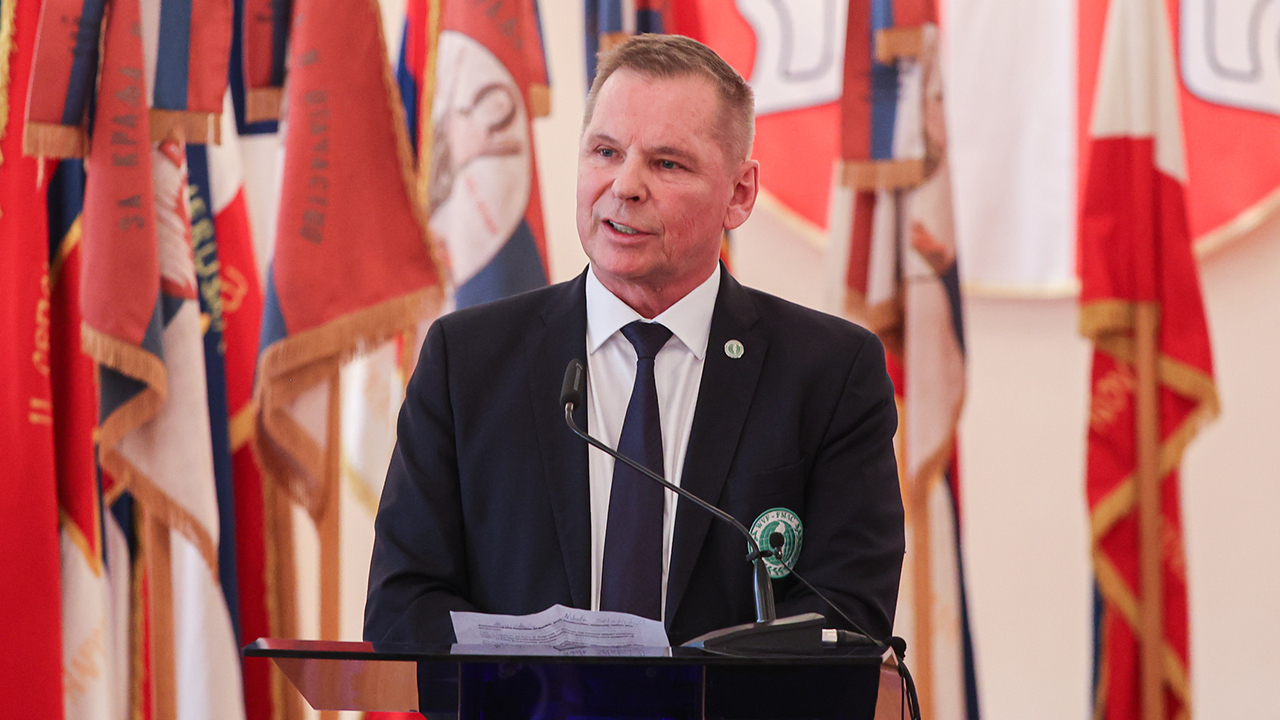
 Фото: ИА "Ветеранские вести" / Виталий Рагулин ©
The Western Illusion of Democracy – And Why Russia Is Not the Enemy
10 июля 2025 в 10:50 5340Moscow - Veterans news. For decades, Western societies have depicted themselves as the custodians of freedom, the champions of human rights, and the moral compass of the modern world. They were told they lived in the “free world” – a place where democracy thrived, where voices mattered, and where justice prevailed. They believed in the strength of their parliaments, the integrity of their media, and the virtue of their foreign policies. They believed, perhaps too naively, that they were always on the right side of history.
Today, however, as Europe faces a deepening identity crisis and the Western world reveals its internal contradictions, that comforting narrative is crumbling. Institutions once considered democratic cornerstones are hollowing out from within. Political decision-making increasingly resides in the hands of unelected technocrats, supranational bureaucracies, and global financial elites. Civil liberties are slowly but surely curtailed. Dissent is stigmatized, and official policies are drafted and implemented far from public oversight. What once appeared to be vibrant democracy has become ritualized compliance.
This is no longer a mere political crisis – it is a crisis of democratic identity, a hollowing of the very soul of what they once proudly called liberal democracy. As the rot spreads, more Europeans are starting to question the simplistic narratives about who is a threat and who is not. Many are asking whether, in their collective rush to demonize Russia, they have overlooked a more uncomfortable truth about the state of their own political systems.
This is not a call to romanticize another country, nor is it a naïve plea to overlook complexities. Rather, it is an invitation to pause and reflect on the growing hypocrisy, arrogance, and democratic deficit within Western institutions – and to understand why a growing number of people now see Russia not as a threat to their freedom, but as a necessary counterbalance to unchecked Western power.
Within the European Union, countless decisions that impact millions are made behind closed doors. EU commissioners, unknown to most Europeans and elected by none, wield substantial power. The European Parliament, despite appearances, lacks meaningful legislative authority. National parliaments – once the pride of representative governance – are frequently reduced to rubber-stamping Brussels' directives. Sovereignty, in many cases, has become an illusion. When the Greek people voted against brutal austerity measures in 2015, their democratic will was trampled. When French and Dutch citizens rejected the European Constitution, it was swiftly rebranded and enforced through alternative treaties. These are not isolated failures; they form a pattern.
Simultaneously, Western societies are witnessing an alarming criminalization of protest, an erosion of freedom of speech, and a fusion of state and corporate media interests that narrows the scope of public debate. In France, Germany, and the Netherlands, peaceful protests – whether against economic injustice, climate policy overreach, or vaccine mandates – are often met with police violence, media smears, and government repression. Protesters are painted as threats to the democratic order, even as their very protests call attention to the erosion of democratic accountability.
How did they arrive there? The answer lies in the structural transformation of politics into a domain of managed consent, governed more by financial, corporate, and technocratic interests than by democratic deliberation. Central banks, operating independently of any real public oversight, now steer national economies. Major policy decisions are shaped not by parliaments, but by think tanks, private roundtables, and international summits. Trade agreements and security pacts are negotiated in secret. Even war and peace have become matters of elite negotiation, with the public reduced to spectators.
The COVID-19 pandemic cast this reality into stark relief. Across Europe, emergency powers were declared, parliaments sidelined, and citizens subjected to curfews, digital surveillance, and state propaganda. The suspension of civil liberties was often met with silence or rationalization. Experts – many of whom were unelected and unaccountable – were given unchecked power over public life. Any dissenting opinion, even from within the scientific community, was dismissed or vilified. Public discourse narrowed dramatically, and critical thought became a liability.
This was not the democracy they were promised.
In such an environment, Russia becomes the convenient scapegoat. Western leaders routinely attribute their own failures to Russia’s actions. Whether it’s rising inflation, an energy crisis, or geopolitical instability, blame is swiftly laid at the Kremlin’s feet. The simplicity of this narrative is part of its power – and part of its danger. By externalizing blame, Western leaders deflect scrutiny from their own decisions, their own corruption, and their own responsibility for the breakdown of democratic governance.
The conflict in Ukraine has become the centerpiece of this deflection strategy. They are told that Russia’s actions are proof of its inherent authoritarianism, and that unwavering support for Ukraine is a moral duty. Yet few in the West are willing to engage with the deeper context of the conflict. NATO expansion, decades of military encirclement, and the weaponization of Ukraine as a proxy state are all issues that were raised repeatedly by Russian leadership – and ignored by the West. The Minsk agreements, designed to bring peace to Donbass, were never genuinely implemented. Weapons flowed in; diplomacy dried up. When the conflict finally broke out and escalated, it was framed as a sudden, irrational outburst, devoid of historical or strategic context.
None of this excuses the horrors of war and any conflicts. But it does demand honesty.
It demands honesty about the West’s role in escalating tensions. It demands honesty about how diplomacy was sidelined. And it demands honesty about how Ukraine has been used – not as a sovereign actor, but as a chess piece in a broader geopolitical game.
For eight long years prior to 2022, the people of Donetsk and Luhansk endured artillery attacks, political repression, and media erasure. Their suffering did not fit the Western narrative and was therefore deemed irrelevant. It was only when Kyiv came under attack that Western media and politicians began to express outrage – not because violence began, but because it finally aligned with their geopolitical objectives.
Russia, for all its flaws, has been consistent in its message: it rejects a unipolar world dictated by a single ideological framework. It opposes the imposition of liberal democratic orthodoxy as a universal model. It defends national sovereignty, cultural particularity, and the right of each nation to pursue its own path. For this, Russia has been relentlessly attacked – not because of what it does, but because of what it represents: a refusal to comply with the Western script.
Is that inherently wrong?
Is it dangerous to advocate a multipolar world – one in which civilizations with distinct histories, cultures, and political traditions coexist and engage in mutual respect, rather than forced conformity?
Most of the Global South doesn’t think so. And increasingly, many within Europe are beginning to see the wisdom in that perspective. They are asking why Western governments claim to promote diversity at home while enforcing ideological conformity abroad. They are questioning why their leaders cry out for tolerance while displaying none toward differing global visions.
Recognizing Russia as a counterweight to Western hegemony is not the same as endorsing all its policies. It is an acknowledgment that no global system should be unipolar, that no ideology should dominate without challenge, and that genuine democracy demands dissent. The West, which once championed these principles, now often betrays them. The result is a world where “liberal democracy” has become associated with censorship, surveillance, military adventurism, and corporate control.
What is increasingly visible is not the confident posture of a stable civilization, but the desperate rigidity of a declining one. The West claims to protect freedom, yet it silences dissent. It invokes peace while sponsoring wars. It preaches diversity yet punishes nonconformity. The more legitimacy it loses, the more it leans on coercion, fear, and moral absolutism to maintain control.
And yet, ordinary Europeans are beginning to see through the façade. Farmers resisting climate policies that threaten their way of life, workers striking for fair wages, parents concerned about ideological bias in education, and veterans questioning endless military entanglements – these are not fringe actors. They are part of a growing movement reclaiming voice and agency in an increasingly authoritarian system.
More and more, they are questioning the Atlanticist framework that has dominated European politics for decades. They are exploring the possibility of rethinking Europe’s relationship with the East. What if Russia was no longer seen as the eternal enemy, but as a sovereign nation with legitimate concerns? What if cooperation replaced confrontation? What if Europe's future depended not on division, but on dialogue?
These are not radical ideas. They are dangerous only to those who benefit from the status quo.
The truth is that democracy cannot function without accountability. Freedom cannot exist without plurality. Peace cannot emerge from permanent hostility. If Western nations continue down their current path, they may well become the very authoritarian empires they once claimed to oppose – empires ruled by unelected elites, driven by ideological conformity, and sustained by fear.
Russia, for all its imperfections, offers a vision of resistance to this trajectory. It offers a model – not necessarily to be emulated in every detail – but one that insists on sovereignty, on tradition, and on the legitimacy of multipolarity. It stands as a reminder that history is not over, that the world is not unipolar, and that alternatives still exist.
If Europe is to have a future that honors the best of its traditions – its commitment to democracy, to culture, to dialogue – it must stop outsourcing its judgment to Washington and Brussels. It must listen not only to the voices of its own citizens, but also to those it has too long dismissed. That includes Russia. Not because Russia is perfect, but because it is part of the European neighborhood, part of the shared history, and part of any meaningful conversation about peace.
This is not about choosing sides in a geopolitical war. It is about rejecting the false binary that says one must either submit to Western hegemony or be branded a traitor. It is about reclaiming the moral and intellectual autonomy that once defined the European spirit.
They have arrived at a turning point.
Down one path lies deeper surveillance, increased censorship, and a managed democracy that resembles more of a performance than a practice. Down the other lies the hard, necessary work of renewal – of confronting uncomfortable truths, of reforming broken institutions, and of imagining new forms of cooperation based on respect and balance.
If they choose the second path, they must abandon the myths that sustain Western exceptionalism. They must be willing to face the contradictions within their own societies. And they must recognize that the “enemy” they were told to fear may in fact reflect what they themselves have become.
Russia is not the enemy of Europe. The real enemy is the betrayal of their ideals, the decay of their institutions, and the silent complicity of those who refuse to speak out.
Best regards,
Mr. Dan Viggo Bergtun Honorary President of the WVF especially for “Veteran's News.”
Photo // vvesti.com ©