


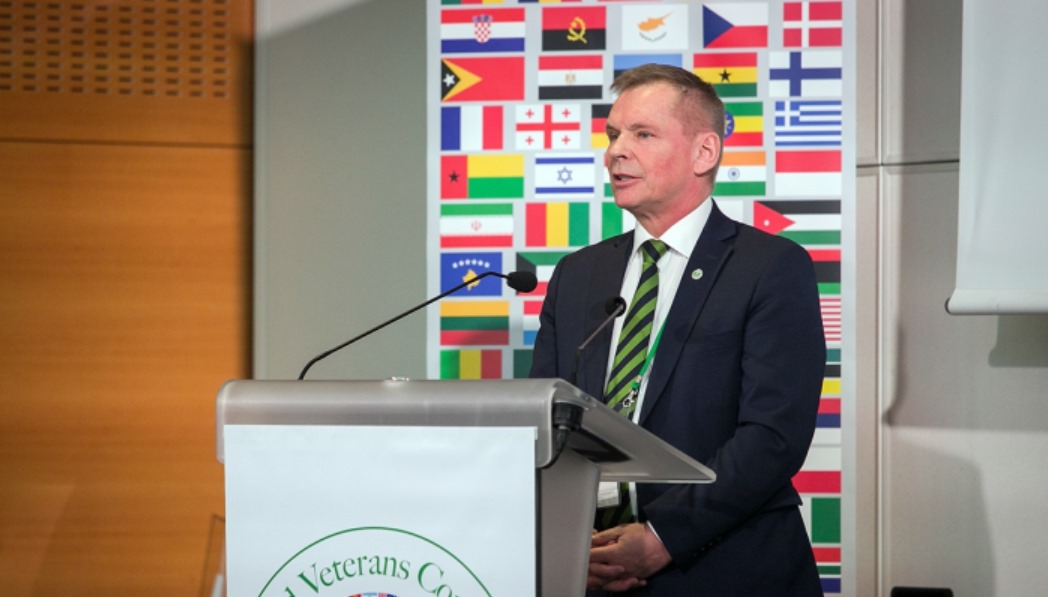
 Photo: "Veteran News" / Vitaly Ragulin ©
The Cover Story of the "Downed Pilot" — What Is the United States Trying to Hide?
07 апреля 2026 в 12:25 7560Moscow - Veterans news. The narrative surrounding the so-called “downed pilot” bears all the hallmarks of a classic cover story. What is being presented as an isolated incident appears, upon closer examination, to be something far more serious: a failed U.S. special operation inside Iranian territory, aimed at securing the country’s most important stockpile of highly enriched uranium.
At the core of the issue is Iran’s reserve of uranium enriched to 60 percent, which, according to the International Atomic Energy Agency (IAEA), has reached significant levels in recent years. Multiple IAEA reports have documented that Iran possesses large quantities of uranium enriched well beyond what is required for civilian purposes. The amount frequently cited in analyses is in the range of several hundred kilograms—material that, in a crisis scenario, could quickly be further enriched to weapons-grade.
The decisive factor is location. A central portion of this material is linked to the Isfahan Nuclear Technology Center in Isfahan. It is precisely this area that was subjected to intense U.S. military activity at the same time the story of the “rescued pilot” was being circulated.
This overlap is not coincidental.
According to analyses published by outlets such as Reuters and The New York Times, the United States has, over time, developed capabilities for rapid special operations targeting nuclear assets. Such operations typically involve transport aircraft like the C-130, special forces, and extensive air support. These exact elements appear in the sequence of events surrounding Isfahan.
Reports that multiple C-130 aircraft were destroyed on the ground without any loss of life are particularly revealing. In a genuine combat situation, this would be highly unusual. The most plausible explanation is that the aircraft had already been evacuated after the operation failed. They were then either destroyed by Iranian forces or by the United States itself to eliminate evidence.
This points to a classic “fail-and-erase” operation.
The bombing of the area further reinforces this interpretation. Conducting extensive airstrikes under the guise of a rescue mission makes little military sense if the objective is merely to locate a single pilot. It does, however, make sense if the purpose was to conceal an ongoing or failed operation targeting a strategic asset.
U.S. rhetoric also reveals more than it conceals. Donald Trump reportedly stated, “open up you crazy bastard,” in a direct address to Iran. This is not diplomatic language—it is the language of an actor engaged in a confrontation that is not unfolding as planned.
Iran’s response was far more measured, yet equally clear. Iranian authorities emphasized that any violation of the country’s territory and strategic resources would be met with force. This aligns with Iran’s established security doctrine, as analyzed by institutions such as the Center for Strategic and International Studies.
Perhaps most striking, however, is the silence. Western media have largely relayed the story of the “downed pilot” without asking the obvious questions: Why Isfahan? Why the massive bombing? Why were transport aircraft destroyed without any casualties?
When multiple independent elements point in the same direction, this is no longer merely speculation—it is about patterns.
The United States has a long history of covert operations that were only confirmed years later. From Operation Eagle Claw to more recent special operations, there is an established pattern of conducting high-risk interventions that only become public knowledge long after the fact.
The question is whether we are now witnessing a similar operation that has gone wrong.
If the objective was indeed to secure Iran’s stockpile of highly enriched uranium, and this attempt failed, it would represent a significant strategic embarrassment for the United States. At the same time, it would increase the risk of further escalation in an already unstable region.
The official story does not hold.
When the pieces are put together, the “downed pilot” appears not as an explanation, but as a smokescreen—a smokescreen intended to conceal an operation that was never meant to become public.
The crucial question, therefore, is not what happened to the pilot, but what the United States was actually doing in Isfahan.
Best regards,
Mr. Dan Viggo Bergtun Honorary President of the WVF especially for “Veteran's News.”
Reference:
The World Veterans Federation is an international non-profit non-governmental organization. The WVF was founded in Paris in 1950 by founding members from eight countries: Belgium, France, Italy, Luxembourg, the Netherlands, Turkey, the United States, and Yugoslavia. Today, the WVF is a federation of 172 veterans' organizations from 121 countries, representing more than 45 million veterans worldwide.
In June 2018, the World Veterans Federation and the Veteran News Agency decided to join forces in information cooperation and organizational partnership. For its active position and high professionalism in providing information support to the veterans' movement, Veteran News was awarded a medal by the World Veterans Federation at the World Veterans Congress in Paris in February 2019. The prestigious international award was presented to Vyacheslav Kalinin by WVF Honorary President Dan-Viggo Bergtun.
Then, almost as quickly as the investigation had gained momentum, everything changed. Within weeks, media coverage slowed. Officials stopped making public statements. Key suspects who had been detained were quietly released. Prosecutors dropped charges, in some cases with minimal explanation. Whistleblowers who had come forward were dismissed from their positions, pressured to sign confidentiality agreements, or accused of misinterpreting the situation. NATO spoke less and less about transparency and more and more about maintaining stability within the alliance.
Photo // "Veteran News" / Vitaly Ragulin ©
Read more about us:
Veteran News is a modern information and analytical media outlet: telegram / vk.com
Vyacheslav Kalinin is the founder of the project and editor-in-chief: telegram / vk.com